
Recording Donegal’s Marine Biodiversity

Beneath the surface of Donegal’s coastline lies a rich and diverse marine environment. From kelp forests and rocky reefs to seagrass meadows, mud habitats, maerl beds and sheltered bays, these underwater ecosystems support an extraordinary diversity of life while providing essential services that benefit both people and the planet.
Yet despite their importance, these habitats remain largely unseen and, in many cases, poorly understood.
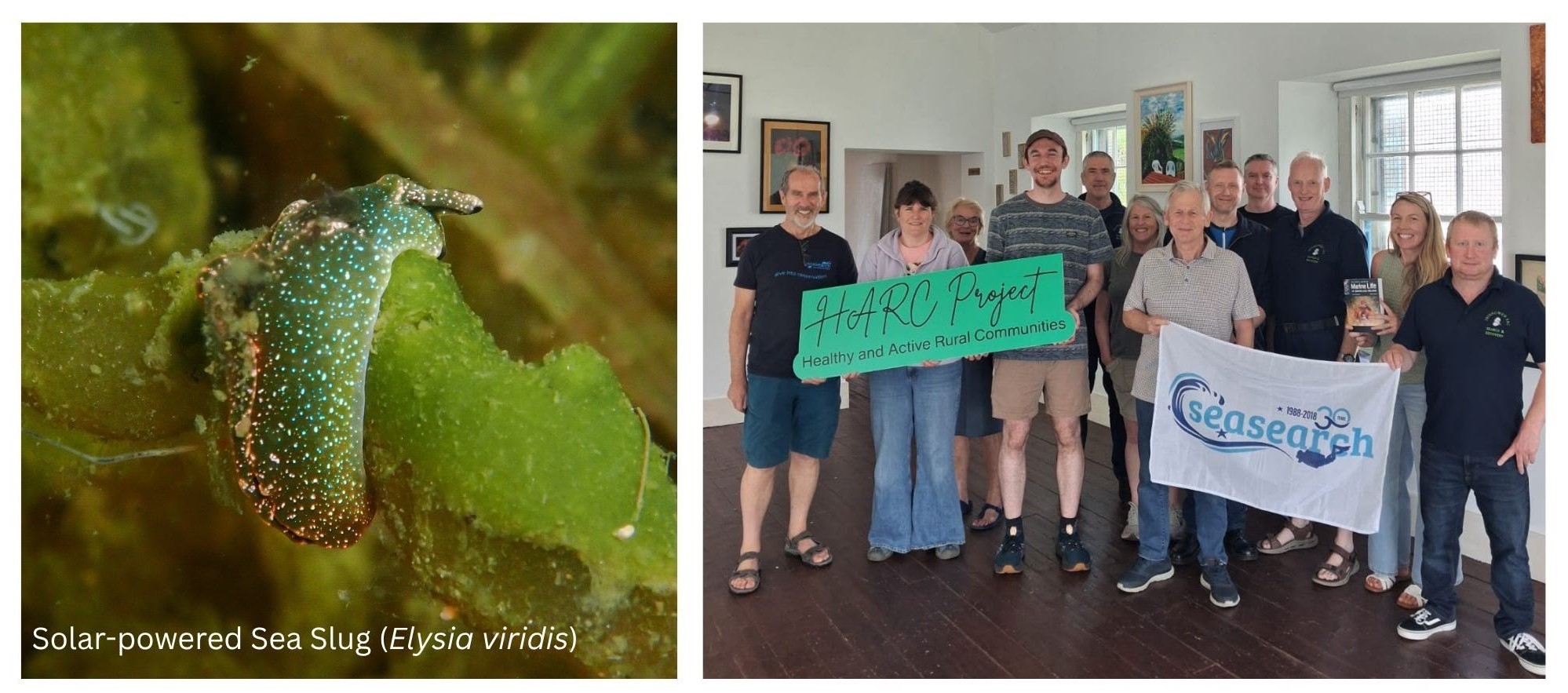
This was the focus of the recent Seasearch Ireland Observer Course held in Donegal, where local divers from Diving Ireland were trained to identify and record marine habitats and species as part of the national citizen science programme, Seasearch Ireland. The course also marked a milestone for Inishowen SAC, with one of our members qualifying as a Seasearch Ireland Tutor. This will help build capacity for delivering future Seasearch training and marine citizen science courses across the north-west. Following a day of classroom learning, participants carried out underwater surveys in Mulroy Bay, documenting a remarkable variety of marine life, including pipefish, sea squirts, anemones, burrowing sea cucumbers, skate egg cases, catsharks, horseshoe worms, a range of seaweeds and crustaceans, and a favourite -the remarkable “solar-powered” sea slugs that retain chloroplasts from the algae they consume.
While these observations may seem simple, every record contributes to a growing body of scientific knowledge that helps monitor the health of Ireland’s marine environment. The divers also recorded a number of invasive sea squirts, including the leathery sea squirt (Styela clava).
All survey records from the course have now been submitted to the National Biodiversity Data Centre (NBDC) through Ireland’s Citizen Science Portal, where they will contribute to the national marine biodiversity database and help inform future research, conservation and management decisions. By visiting the NBDC Biodiversity Maps and searching for a particular species, you can view these records on an interactive map and see where they were recorded during the survey, along with other biodiversity records from across Ireland.

Donegal’s waters are home to internationally important blue carbon ecosystems, including seagrass meadows, kelp forests and saltmarshes. These habitats capture and store carbon dioxide from the atmosphere, helping to mitigate climate change while also stabilising coastlines, improving water quality and providing vital nursery grounds for fish and invertebrates. Healthy blue carbon habitats are increasingly recognised as one of nature’s most effective climate solutions, yet they remain vulnerable to physical disturbance, pollution and the effects of climate change.
The importance of healthy oceans extends far beyond our coastline. Scientists estimate that the world’s oceans produce between 50 and 80 per cent of the oxygen we breathe, largely through microscopic marine plants known as phytoplankton. These organisms, although invisible to the naked eye, form the foundation of marine food webs, supporting everything from shellfish and commercially important fish species to seabirds, seals, dolphins and whales. However, the marine environment is undergoing rapid change.
The oceans have absorbed more than 90 per cent of the excess heat generated by climate change, resulting in rising sea temperatures and increasingly frequent marine heatwaves. At the same time, the oceans absorb around a quarter of the carbon dioxide released into the atmosphere each year. While this slows the rate of global warming, it comes at a cost. As carbon dioxide dissolves into seawater, it causes ocean acidification, altering the chemistry of the sea and making it more difficult for many organisms, including shellfish, corals and certain plankton species, to build and maintain their shells and skeletons.
These changes begin at the very base of the marine food chain. Phytoplankton, microscopic animals and shell-forming organisms support almost every other species in the ocean. When these foundational species are affected, the consequences extend throughout the ecosystem, influencing fish populations, marine mammals, seabirds and, ultimately, the resilience of the entire marine environment. A worrying recent study showing the decline in plankton should concern us all.
Climate change is a global challenge, but many of the pressures affecting our coastal waters are local and can be addressed within our own communities. Pollution, marine litter, sedimentation, nutrient runoff, habitat damage and the spread of invasive non-native species all place additional stress on ecosystems already coping with a changing climate. Reducing these local pressures gives marine habitats a greater opportunity to recover and adapt, strengthening their resilience to future environmental change.
This is where citizen science has become increasingly important.
Through programmes such as Seasearch Ireland, trained volunteer divers and snorkelers collect information on marine habitats and species that would otherwise be impossible to gather at the same scale. Every survey contributes valuable baseline data, allowing scientists to monitor long-term environmental change, identify emerging threats, map sensitive habitats and provide the evidence needed to inform marine conservation and management.
Marine conservation is no longer solely the responsibility of researchers or government agencies. As divers, snorkellers, anglers, sailors and coastal communities, we all have the privilege and an important role to play on and beneath the surface. By recording wildlife, reporting invasive species, reducing plastic pollution, supporting habitat restoration projects and promoting the responsible use of our seas, local communities can make a meaningful contribution to protecting Ireland’s marine biodiversity.
The recent Seasearch Ireland course in Donegal demonstrated not only the exceptional biodiversity of our local waters but also the enthusiasm of volunteers to help learn to safeguard it. Every species identified, every habitat surveyed and every record submitted strengthens our understanding of the marine environment and provides the evidence needed to protect it into the future.
As the old conservation principle reminds us, we cannot protect what we do not know exists. By exploring, recording and understanding our marine environment better, as divers and as citizen scientists we take the first and most important step towards ensuring that these extraordinary marine ecosystems continue to thrive for generations to come.
….
A huge thank you to everyone who took part in the Seasearch Ireland Observer Course, to the Seasearch Ireland tutors for sharing their knowledge and expertise, and to The HARC Project and Inishowen Development Partnership for their generous support in funding the course.

Comments are closed